

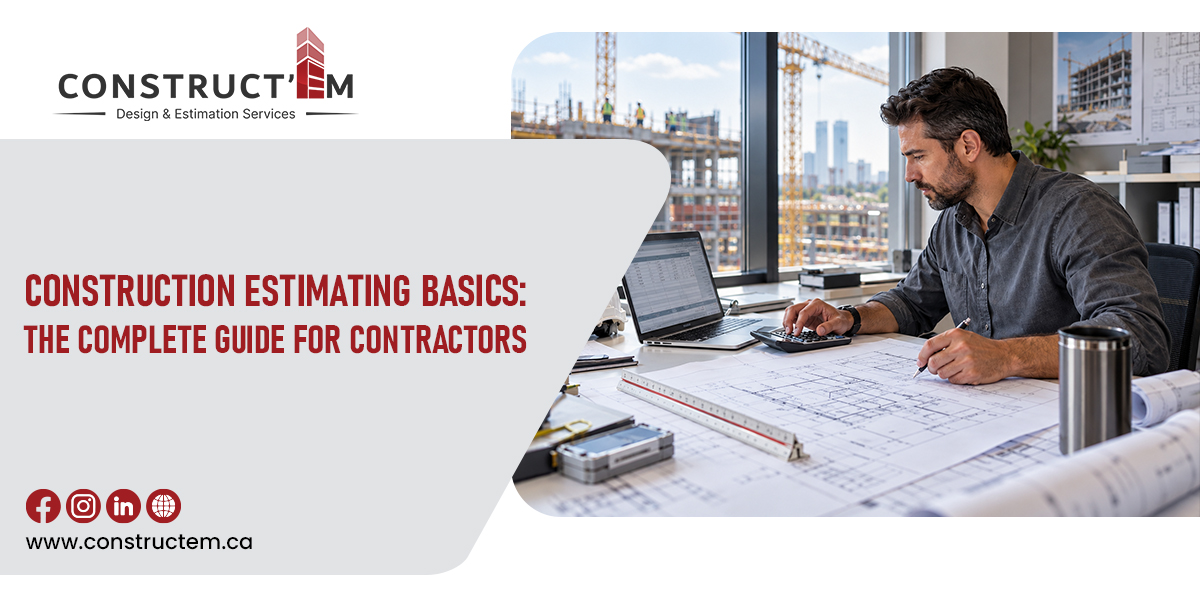
Ever sat in your truck late at night, staring at a stack of blueprints, wondering if your bid is going to win the job or accidentally cost you your shirt? You are not alone. Construction estimating is the invisible backbone of every profitable project, yet it remains one of the most stressful parts of the trade. Too many contractors rely on gut feelings or back-of-the-napkin math, only to watch profit margins evaporate halfway through a build due to hidden material spikes or underpriced labor.
According to data from the U.S. Bureau of Labor Statistics (BLS), construction profit margins are notoriously tight, often hovering between 1% and 5%, meaning even a small estimating error can push a project into the red.
However, estimating doesn’t have to be a guessing game. This guide breaks down everything you need to know, from decoding project scopes and calculating true labor costs to evaluating modern software and knowing when to leverage Professional Construction Estimating Services in Canada.
At its core, a construction estimate is your best statistical prediction of what a project will cost to build from the ground up. It isn’t just a random price tag thrown at a client; it is a financial roadmap.
Reliable construction estimating services for every single dollar required to deliver the project safely, on time, and up to code. It bridges the gap between architectural dreams and physical reality, outlining what the client will pay and what you need to keep your business profitable.
Read Also: Top 5 Factors to Choose the Best Construction Estimating Company
Get precise material takeoffs, labor costs, and project estimates to bid confidently and protect your profit margins.
Get Your Construction Estimate
A rock-solid estimate isn’t just a random number; it’s the sum of every moving part required to bring a blueprint to life without eating into your profits. Whether you are pricing a project yourself or evaluating professional Construction Estimation Services in Canada, every accurate bid breaks down into a few core cost centers:
Materials form the physical skeleton of your project. Beyond the base sticker price of lumber, concrete, or steel, you have to account for shipping, local sales tax, and a reliable waste factor, usually adding 5% to 10% to cover cuts, breakage, and job-site loss.
Labor is often the most volatile variable on any job site. You aren’t just paying an hourly wage; you are factoring in payroll taxes, workers’ compensation insurance, and realistic crew productivity rates that account for fatigue, weather, and site conditions.
Whether you own your iron or rent it for the week, machinery adds up fast. Make sure your estimate covers transport fees, daily fuel usage, routine maintenance, and wear-and-tear.
Our subs run the electrical, plumbing, or HVAC work. To stop overlap and to prevent missed tasks, ask for written bids and line them up with your main job scope.
Plan for overhead so the work can keep moving. This usually covers trucks, software costs, insurance, and office rent. Then set your profit goal. Add a contingency amount, often 5% to 10%, for site issues you did not expect or for materials that jump in price.
Read Also: Top Residential Construction Estimating Services for Renovations
Pull out the architectural and structural drawings. Read every single page, review the specifications manual, and pay close attention to general conditions and local site constraints before touching a calculator.
Break the drawings down into distinct building components. Use digital takeoff tools or manual scaling to calculate accurate linear feet, square footage, and cubic yards for every material assembly.
Never rely on pricing from a job you did two years ago. Check in with local suppliers to lock down today’s actual material costs for your specific geographic region.
Calculate the total man-hours required for each task, multiply them by fully burdened labor rates, and layer in the daily operating costs for any heavy machinery or specialized tools needed on-site.
Factor in site-specific requirements like building permits, temporary toilets, security fencing, dumpsters, utility hookups, and mandatory safety equipment.
Run through a systematic peer review or self-audit. Double-check your math, ensure your scope matches the client’s request, and verify that your overhead and profit targets are securely baked in.
Estimates evolve as a project matures. In the early planning phase, you might issue a rough order of magnitude (ROM) or conceptual estimate based on historical square-foot costs to help a client check feasibility.
As designs develop, you move to a preliminary estimate during the design phase. Finally, once the blueprints are fully engineered and finalized by a good estimator or construction estimating services, you produce a definitive or detailed estimate- the hard number you use to sign a binding contract and build the project.
Read Also: Top 10 Benefits of Hiring a Construction Estimating Company
Precision is everything; if your material takeoff is off by even a small percentage, your entire financial foundation crumbles.
Construction costs vary wildly by zip code. A framing package in downtown Toronto will look completely different than one in rural Alberta.
A great estimate reflects how fast your specific crew actually works, factoring in local wage rates and burdens rather than overly optimistic production assumptions.
Nothing is left to chance or assumed “someone else’s job.” Every line item, from foundation to finish trim, is accounted for.
Transparent communication protects you. Explicitly state what is included in your price and what is explicitly left out, such as rock excavation or utility upgrades.
Modern estimating software ranging from Bluebeam and Procore to Buildertrends and STACK can supercharge your workflow. According to industry insights, digital takeoff tools can cut estimating time by up to 50% while dramatically reducing human calculation errors.
However, software is only as smart as the person using it. A program can measure a wall in seconds, but it cannot know that your local supplier is running low on stock or that a specific subcontractor always tacks on hidden fees. Software speeds up the math; your experience makes the call. But when your plate is too full to handle takeoffs in-house, partnering with an experienced Construction Estimating Company can bridge the gap.
Read Also: How to get Construction Estimating Services Canada During the Winter Season?
When looking for a reliable Construction Estimating Company Canada to support your bids, keep these key factors in mind:
While speed matters when you are up against a hard municipal tender deadline, accuracy and depth of review should always beat a rushed job.
Ensure the estimating service or professional you hire deeply understands Canadian building codes, regional supply chains, and your specific trade.
Projects change. Clarify upfront how your construction estimating partner manages addenda, design updates, and post-bid scope modifications.
Get a clear agreement on what deliverables you are getting, whether it is a raw material takeoff, a full pricing breakdown, or a complete bid package ready for review.
Ultimately, a solid construction estimate is the bridge between a winning bid and a profitable business. For projects operating stateside or looking for general support, utilizing comprehensive Construction Cost Estimating Services ensures you lock down precise numbers. Always protect your margins with a 5% to 10% contingency buffer, and leverage estimating software to cut your takeoff time in half while letting your field experience guide the final call.
If you want expert support to streamline your bidding, Constructem and their specialized Construction Cost Estimation Services in Canada can help you lock down precise numbers. For more tips, connect with us on our social media channels like Instagram and LinkedIn. Getting your estimates right ends late-night stress, protects your hard-earned cash, and sets your contracting business up for sustainable growth.
Strong habits include exact material takeoffs. Use current local prices. Pick labor rates that fit the area and the work. Do not miss parts of the scope. Write down the assumptions in a clear way for the project.
The 0.6 rule is a rapid sizing formula stating that equipment or plant costs scale relative to capacity raised to the 0.6 power.
Use first principles estimating to build the cost from the start. Split each task into clear pieces. Then estimate the materials by amount. Next, figure out the labor hours. Finally, note the equipment you will need.
The unit price method is widely used. It works by taking the work quantities and matching them with known line item costs. Then it adds up the totals from those items.
Be a careful estimator. Watch the details closely. Keep up with material market changes. Review older project results. Also, understand what the site is really like.
A good construction cost estimating service will include four vital qualities: analytical precision, strong mathematical skills, deep knowledge of construction methods, and the discipline to maintain thorough, organized project records.

days day
hours hour
minutes minute
seconds second
Lock in UP TO 50% off before your quote reservation expires.
Precision material takeoffs & cost estimates delivered fast for Canadian Contractors.