

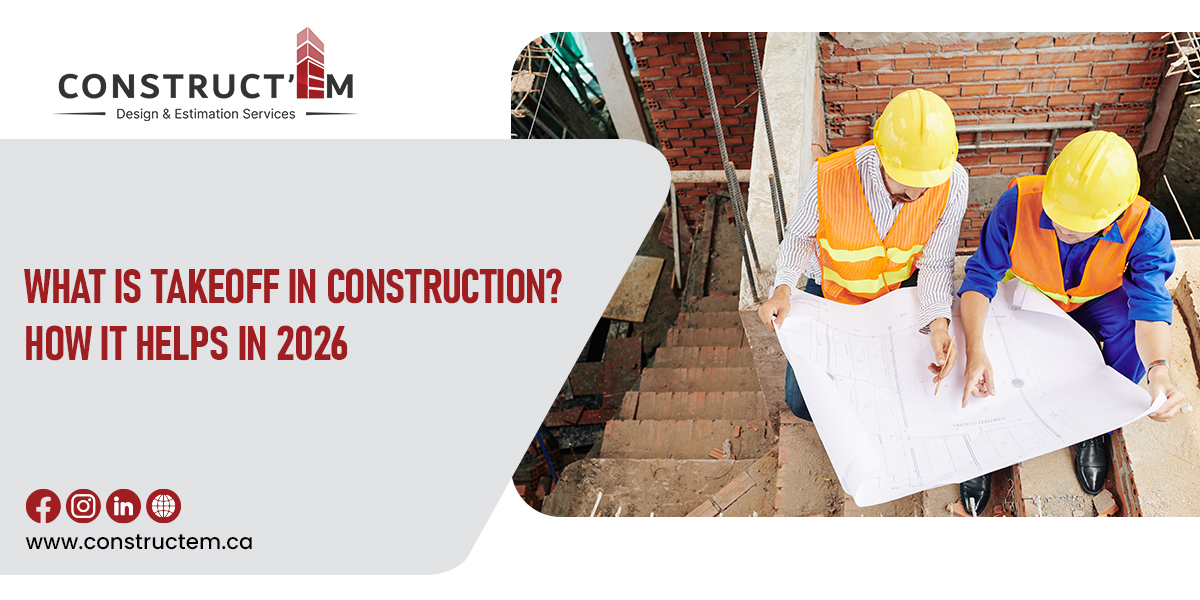
Everything is precise in the world of construction nowadays. One error could delay your project, throw your budget off, or waste materials. That’s why construction takeoff services have become the core of every project every single time in 2026. Contractors use takeoffs to know exactly what materials and how much of each they need before they lay bricks. If you thought a construction takeoff was just a list, think again.
It is the strength of the planning. It converts drawings into quantities to enable those teams to develop more accurate budget and schedule estimates. Constructem Canada and other such companies are at the forefront of this trend, offering contractors an accurate, efficient takeoff that is complete at every project stage.
A construction takeoff is a meticulous examination of project drawings to determine and quantify the scope of materials needed to complete the job. It includes all the materials required for the construction, such as the concrete and steel for the major structural members and the finishing materials like tiles, paint, drywall, etc. Rather than working from educated guesses or assumptions, contractors are provided with exact numbers that quantify what they have to do.
A construction takeoff is when you measure and list all the materials needed for a job from the drawings and specifications. It includes:
In a CAD case, it turns blueprints into data you can use. Professional takeoffs are intended to be complete, strict, and realistic and consider the actual conditions of the construction rather than just the walls.
Professional construction takeoff services do more than just provide numbers. You can use these pieces of information to enhance every phase of a project.
Accurate quantities mean accurate budgets. Contractors can confidently budget for costs, knowing exactly what they will entail.
Over-ordering wastes money. Under-ordering causes delays. Takeoffs ensure the right balance.
With clear data, teams can schedule tasks, deliveries, and labor more efficiently.
Suppliers respond faster when they receive precise material lists. This speeds up the procurement process.
Contractors with detailed takeoffs submit more accurate bids. This increases their chances of winning projects.
Construction estimator have a far greater responsibility than that in 2026. They’re not only crunching numbers, but they’re influencing project decisions. They review drawings and takeoffs and assess risks prior to construction. With professional services support, they can concentrate on strategy, not on the number crunching. This change has led to better, faster, and more useful estimation
Takeoffs don’t just help with planning; they also reveal issues that are easy to miss.
In trades like drywall or tile work, small errors can lead to large material waste. A detailed takeoff identifies these inefficiencies early.
Even minor miscalculations can increase project costs. Professional takeoffs reduce these risks significantly.
Less waste means fewer resources are used. This supports environmentally responsible building practices.
One common issue in construction estimation is the overlap trap, especially in steel and rebar takeoffs. This happens when overlapping materials are counted more than once. The result is inflated quantities and higher costs. Experienced construction estimator know how to detect and correct these overlaps. Professional services ensure that every measurement is accurate and realistic.
Constructem Canada has built a strong reputation for delivering reliable construction takeoff services. Their approach combines technology, expertise, and attention to detail.
Here’s what makes them stand out:
By working with Constructem Canada, contractors can reduce stress and focus on execution instead of calculations. You can also connect with them on Facebook for updates and insights.
The future of construction takeoff services is evolving rapidly, as new technologies are enabling the process to become faster, more intelligent, and increasingly reliable. AI-powered tools are helping estimators deliver accurate outputs with minimal human effort, and with Building Information Modeling (BIM) integration, teams can work together on detailed, data-rich models.
The result is that a change in any design is reflected automatically in the quantity takeoff in real time, so you can rest assured that your counts are updated and consistent, limiting the potential for errors. At the same time, the automatic quantity estimating is also gaining momentum in terms of time savings and productivity improvement on projects. With these innovations, contractors can make better, faster decisions, and as with previous technology disruptions, the early adopters will be the big winners in the industry.
Initiating a building project without the right construction takeoff services and calculations may cause confusion, material shortages, skyrocketing prices, and unforeseen lag times, which may interfere with the entire work schedule. In comparison, a professional takeoff brings everything in order and predictability; orders the materials in the right amount; the budget remains controlled; and work flows without endless stops and starts. This stark contrast illustrates that precision takeoffs are not merely beneficial but are crucial in maintaining the efficiency, cost-effectiveness, and timeliness of today’s construction projects.
Construction estimates are the root of an effective project in 2026; these provide the clarity and accuracy to plan, budget, and execute. With top-notch takeoff services for construction and support from Constructem Canada, contractors can increase productivity, reduce costs, and remain competitive in a challenging industry. An accurate takeoff is more than just numbers; it’s about building smarter, faster, and better.
No, it’s a detailed calculation based on project drawings and specifications.
They are faster, more accurate, and easier to update.
Yes, especially in trades like drywall and tile work.
Because they receive clear and accurate material details.
It’s when overlapping materials are counted multiple times, increasing costs.

days day
hours hour
minutes minute
seconds second
Lock in Flat 30% off before your quote reservation expires.
Precision material takeoffs & cost estimates delivered fast for Canadian Contractors.