

If you have ever constructed a house, remodeled a kitchen, or even thought about it, then you know one thing for certain—construction estimating services isn’t inexpensive. But how does a project cost get determined prior to construction? How do contractors make sure they don’t spend too much or charge too little? And how do owners protect their investment from the unknown?
Every successful construction project whether a house, a city skyscraper, a hospital, or even a public park is driven by a well-researched, well-established estimate behind the scenes.
Estimates may not be heroic, but they surely are a part of our industry that keeps things on track. In this blog, we are going to break it down. What is construction estimating anyway? Why is it so important? And how can the right estimating services save you a ton of time, money, and headaches?
Let’s get started.
The technique of projecting a building project’s overall cost before it starts is known as construction estimation. This comprises:
Estimates can be highly detailed documents created right before construction starts, or they can
Construction estimating services is full of moving parts. If you don’t have a solid grip on the costs, things can go sideways quickly. Here’s why estimating is a must-have for everyone involved—from homeowners to contractors to developers:
Without knowing how far you need to go or how much fuel you’ll need, would you embark on a road trip.
An accurate estimate is essential for builders and contractors. Profits are lost when underestimating. Overestimating could result in a complete loss of the bid. Where’s the sweet spot? an accurate, competitive estimate that safeguards your profit and accounts for all expenses.
Estimates evolve as a project develops. Here are the common types:
As design progresses, more details are available. This estimate adjusts with better accuracy and helps refine budget planning.
Prepared right before construction begins. It’s highly detailed, with line items for every material, task, and cost. Contractors use this to prepare bids.
This is what contractors submit when competing for a project. It includes direct and indirect costs, profit margins, and more.
Used during construction to monitor and control ongoing costs compared to the original budget.
Construction estimating isn’t just number-crunching—it’s a mix of experience, intuition, and data analysis. Depending on the project, estimators could include:
To improve speed and accuracy, many professionals today use programs like Planswift, RS Means, Bluebeam, Human judgment is still very useful, though, especially when handling intricate websites, unique designs, or changing market conditions.
Time is money in construction. Estimators consider project duration and scheduling to include indirect costs accurately.
Well-organized estimates help clients understand what they’re paying for—and help contractors justify costs.
Think of construction estimating as a financial shield. Here’s how it directly benefits your wallet:
Even experienced pros can make mistakes. Here are a few red flags to watch out for:
Eyeballing material needs without takeoffs leads to over/underordering. Use proper takeoff software or tools.
You can’t estimate for soil quality, access issues, or terrain challenges unless you’ve seen the site or studied accurate site data.
We’ve talked about numbers and costs, but let’s not forget the human side.
Behind every estimate is someone trying to build something meaningful—a family home, a safe school, a healthcare facility, a business’s new headquarters.
For project owners, an estimate offers peace of mind. For contractors, it’s a roadmap to profit. For communities, it’s the beginning of progress.
AI is learning to analyze thousands of past projects to help predict costs with remarkable accuracy.
Cloud-based tools now integrate live pricing from suppliers, giving estimators instant updates on material cost estimates.
As green construction grows, estimators are now factoring in lifecycle costs, energy efficiency, and sustainable materials.
The future is fast—and smart estimating is keeping pace.
Building success requires more than just bricks and beams; it begins with a well-thought-out estimate. Construction estimating services offer the assurance, clarity, and control required to realize a project without unanticipated financial setbacks. The foundation of a successful build is precise estimating, which helps to secure fair bids, prevent expensive errors, and keep projects on schedule.
What are construction estimating services?
Construction estimating services help forecast the total cost of a building project before it begins. This includes materials, labor, equipment, permits, overhead, and profit margins, ensuring projects are planned accurately from the start.
Why are construction estimates important?
Accurate estimates prevent cost overruns, help contractors submit competitive bids, give owners financial clarity, and keep projects on schedule without unpleasant surprises.
Who needs construction estimating services?
They’re essential for contractors, developers, architects, homeowners, and project managers—basically anyone involved in planning, bidding, or building a construction project.
Who prepares construction estimates?
Estimates are typically prepared by professional estimators, quantity surveyors, project managers, or specialized third-party estimating firms. Some companies also have in-house estimating teams.
What are the main types of construction estimates?
What tools are used in modern estimating?
Popular tools include PlanSwift, RS Means, Bluebeam, and cloud-based platforms that pull real-time supplier pricing. AI-powered tools are also emerging to predict costs with higher accuracy.
How do construction estimating services save money?
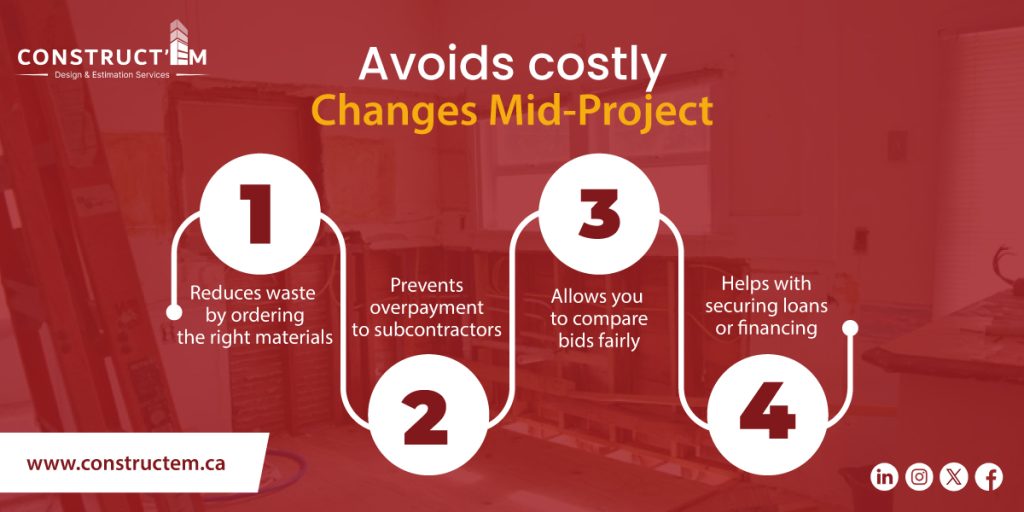
They reduce waste, prevent costly mid-project changes, ensure accurate material orders, and allow fair bid comparisons. They also help secure financing by providing lenders with reliable cost data.
What happens if a project doesn’t have an accurate estimate?
Without accurate estimates, projects risk going over budget, facing delays, running out of funds, or even failing altogether.
Are AI tools replacing human estimators?
No. AI tools speed up calculations and provide data insights, but human expertise is still critical for site-specific factors, unique designs, and adapting to unexpected changes.

days day
hours hour
minutes minute
seconds second
Lock in Flat 30% off before your quote reservation expires.
Precision material takeoffs & cost estimates delivered fast for Canadian Contractors.