

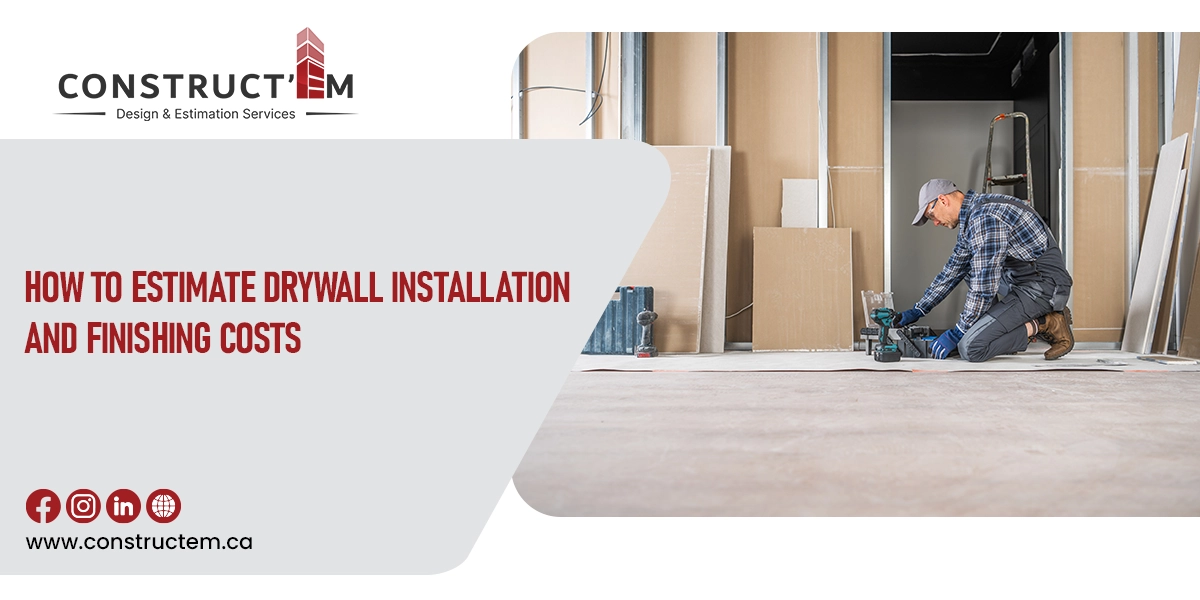
Every Accurate Drywall Project Starts with a Reliable Estimate. An effective drywall project relies on quality work as well as on a precise estimate. Even minor mistakes in measuring the materials,
calculating labor costs, or failing to account for finishing details can have a serious impact on the budget and profits of the project at hand.
No matter if you’re bidding on a project in residential renovations, commercial real estate business, or institutional development, proper estimation of drywall installation and finishing costs is a must.
For this reason, many builders turn to expert drywall estimating services when making bids for budget control. With increasing competition, construction project estimation is thriving in Canada.
Drywall cost per sheet and labour: The estimate for the supply, hanging, and finishing of drywall sheets to provide smooth, durable walls and ceilings.
But the overall cost of the project is more than the cost of sheets of drywall. Subcontractors are responsible for considering labour, finishing and materials, equipment, waste, difficulty of the project, and scheduling when formulating an accurate quote.
Since no two building projects are the same, drywall prices differ according to project size, design of the building, height of the ceiling, ease of access, and amount of finish required.
A comprehensive estimate takes all of these variables into account prior to the commencement of construction, limiting the potential for budget overruns and change orders.
Skilled estimators will also analyze all construction plans with precision to determine the amount of drywall, sections of partitions, ceiling systems, and special constructions.
This type of planning allows contractors to submit bids that are accurate and that will ensure a healthy profit margin.
For Canadian contractors, the challenge lies not only in the inherent complexities of the construction elements and associated labour, but also in the continually changing prices of materials, labour costs varying from one region to another, and building code requirements that are continuously evolving.
To spend time on a solid estimate can often result in more effective financial management of the project as a whole.
Preparing an accurate drywall estimate offers benefits that extend far beyond winning a project.
A detailed estimate helps contractors:
Accurate estimating also strengthens communication between servicers, dealers, and project owners. When every figure and cost is known clearly, plans tend to run more smoothly and on schedule and on budget.
With building projects growing more complicated, contractors are focusing more on detailed planning and less on experience or rough approximations.
Numerous variables influence drywall installation and finishing costs. Understanding these factors allows contractors to create more realistic estimates while avoiding unexpected expenses during construction.
The overall square footage of walls and ceilings is one of the biggest cost drivers.
Larger projects usually reduce the cost per square foot because labour and equipment can be used more efficiently. Smaller projects, however, often have higher unit costs due to setup time and minimum labour requirements.
Not every project uses a standard gypsum board.
Depending on the building’s requirements, contractors may need:
Each product has a different material cost and installation requirement, directly affecting the final estimate.
Labour is one of the largest components of any drywall project.
Installation productivity depends on several factors, including:
Regional wage differences across Canada should also be considered when estimating labour expenses.
Higher finish levels require:
As a result, premium finishes increase overall installation costs.
Waste is often underestimated during project planning.
Drywall sheets must be cut to fit walls, ceilings, windows, and doors. These cuts generate offcuts that cannot always be reused.
Estimators typically include an appropriate waste allowance based on:
Proper waste calculations help prevent costly material shortages later in the project.
Projects with high ceilings require additional equipment such as lifts, scaffolding, or extended ladders. Similarly, buildings with restricted access may increase installation time because materials must be transported manually through narrow spaces or multiple floors.
These logistical challenges should always be reflected in the estimate.
Construction schedules can also impact drywall costs.
Accelerated timelines may require:
While these measures help meet deadlines, they also increase project costs.
Creating an accurate drywall estimate requires more than simply measuring wall dimensions. Professional estimators follow a structured process that captures every cost component before construction begins.
The first step is a comprehensive review of the architectural drawings, reflected ceiling plans, elevations, and project specifications.
This review helps identify:
Carefully reviewing the drawings before performing quantity takeoffs reduces the risk of omissions that could lead to inaccurate bids.
Once the drawings have been reviewed, the estimator performs a drywall takeoff to determine the total quantity of materials required.
A professional drywall takeoff typically includes:
Modern estimating software improves the speed and accuracy of digital takeoffs by reducing manual calculations and minimizing human error.
After completing the drywall takeoff, the next step is calculating the total material requirements. Every item should be measured carefully to avoid shortages or excessive ordering.
A complete material estimate generally includes:
Material prices can vary across Canadian provinces due to transportation costs, supplier availability, and market demand. Contractors should always use current supplier pricing instead of outdated cost databases.
Accurate material calculations improve purchasing efficiency and reduce unnecessary waste, helping projects stay within budget.
Labour often represents the largest portion of drywall installation costs. Estimators must calculate the number of labour hours required based on the project’s size and complexity.
Several factors influence labour productivity, including:
Projects with curved walls, vaulted ceilings, or custom architectural details typically require additional labour hours. A realistic labour estimate ensures contractors submit competitive bids without sacrificing profitability.
Many drywall estimates overlook equipment expenses, which can significantly affect the final project cost.
Common equipment includes:
Other indirect costs may include:
Including these expenses creates a more complete and reliable estimate.
No construction project is completely waste-free. Drywall sheets must be cut around doors, windows, ceilings, electrical outlets, and mechanical systems.
Professional estimators typically include an appropriate waste factor based on the project’s design complexity.
A contingency allowance may also be added to account for:
These allowances help contractors avoid unexpected costs during construction.
Drywall installation is only one part of the overall project. Finishing plays a major role in determining the final appearance and labour cost.
Drywall finishing generally includes:
Higher finish levels require additional labour and materials, increasing the total project cost.
Premium commercial spaces often require smoother finishes because imperfections become more visible under bright lighting.
Estimating finishing costs accurately prevents underpricing and improves overall project profitability.
Even experienced contractors can make estimating mistakes that reduce profit margins. Understanding these common errors helps improve bid accuracy.
Preparing a detailed drywall estimate requires technical knowledge, experience, and time. Many contractors choose professional drywall estimating services to improve bid quality while focusing on project execution.
Professional estimators provide:
These services help contractors submit competitive bids without overlooking critical project costs. Whether working on residential, commercial, or institutional projects, outsourcing estimating allows businesses to improve productivity while increasing bid confidence.
The term drywall estimating services refers to the professional process of calculating all costs associated with drywall installation and finishing. This includes quantity takeoffs, labour estimates, material pricing, waste calculations, equipment requirements, and project-specific cost analysis.
These services help contractors prepare accurate bids, manage project budgets, and reduce financial risks before construction begins.
Similarly, construction estimating in Canada involves preparing detailed cost estimates for various construction trades while considering Canadian labour rates, regional material pricing, transportation costs, and local building code requirements.
As construction projects become more complex, contractors increasingly rely on professional estimating services to improve planning, maintain profitability, and make informed business decisions.
Companies like Constructem Canada provide specialized estimating solutions that help contractors save time, improve bidding accuracy, and successfully manage projects of all sizes.
Accurately estimating drywall installation and finishing costs is essential for delivering successful construction projects. Every estimate should account for material quantities, labour requirements, finishing levels, equipment, waste, and project-specific conditions.
A well-prepared estimate reduces financial uncertainty, improves bidding accuracy, and helps contractors complete projects on time and within budget. As the Canadian construction industry continues to evolve, reliable estimating practices have become a competitive advantage for contractors seeking long-term growth.
Professional drywall estimating services simplify the estimating process by providing detailed quantity takeoffs and precise cost analysis. Combined with expert construction estimating in Canada, these services help contractors make informed decisions, reduce risk, and improve overall project performance.
If you’re looking for dependable estimating support, Constructem Canada offers accurate drywall takeoffs and construction estimating solutions tailored to residential, commercial, and industrial projects across Canada.
Visit Constructem Canada to learn more about our estimating services, and stay connected with us on Facebook, Instagram, and our other social media channels for construction insights, estimating tips, and industry updates.
Drywall installation costs are estimated by calculating material quantities, labour hours, equipment expenses, finishing requirements, waste allowances, and project overhead. A detailed drywall takeoff combined with current material pricing produces the most accurate estimate.
Several factors influence drywall costs, including:
Each factor should be evaluated carefully to develop a realistic project budget.
Contractors can lower installation costs by:
These practices improve project efficiency while protecting profit margins.

days day
hours hour
minutes minute
seconds second
Lock in UP TO 50% off before your quote reservation expires.
Precision material takeoffs & cost estimates delivered fast for Canadian Contractors.