

One of the biggest challenges in project planning and management is accurately estimating construction costs. Whether it’s a residential building, commercial complex, or large infrastructure project, precise cost forecasting is essential for project success.
At Constructem, our Cost Estimating Services in Canada combine careful calculations, professional expertise, and creative problem-solving. Estimators first apply scientific methods to measure floor areas, concrete volumes, and steel quantities. From there, the artistic side comes into play, interpreting designs and making judgment calls to refine the final cost.
No two estimators will arrive at the same total cost from the same drawings and specifications, because cost estimation is both a science and an art.
The Art and Science of Construction Cost Estimating
In Canada, construction estimation services are a critical part of project planning. Accurate estimates help clients stay on schedule, prevent costly mistakes, and allocate resources efficiently. From foundations and freeways to large commercial complexes, our estimators balance technical accuracy with practical insight to deliver reliable results.
- Detailed quantity takeoffs using drawings and specifications
- Use of historical cost data and industry benchmarks
- Advanced estimating software for precision and efficiency
- Professional judgment to interpret designs and anticipate challenges
- Adjustment for regional factors such as labor rates and material availability in Canada
- Risk assessment and contingency planning to manage uncertainties
From foundations and highways to large commercial and industrial projects, this combination of structure and expertise allows estimators to deliver reliable, realistic cost estimates. The result is improved cost control, better resource allocation, and greater confidence for clients at every stage of the project. Save Thousands on Your Next Project with Construction Takeoff Services
Understanding Cost Work Estimation
A full cost work estimation will now review the entire construction process to the end ensuring an achievable budget for your project and for your financial planning. Site conditions, methods of construction, and labor productivity are key contributors to the overall cost of the project. Estimators also take into account regional and operational factors that can influence the cost of doing business as well as materials. As a result, many Canadian construction projects are subject to more diverse weather conditions, tighter safety regulations, and different regional labor rates, which must be factored in the estimates.
The following are some of the significant cost work estimation items among others;
- Site preparation and excavation (including soil testing and foundation work)
- Form and reinforcement necessities for the structural design of the building
- Labor charges, productivity levels, and work force availability
- Duration of use and cost of equipment and machines
- Variations in the prices of materials and the availability of suppliers
- Canadian codes and safety standards
- Provisions for contingencies for risks and unexpected situations
- Cost estimating services in Canada package technical calculations with industry know-how to develop budgets that mirror true construction conditions.
These holds spending in check, facilitates better decision making, and prevents surprises during execution of the project.
Why Cost Estimating is Important
- Cost planning, budgeting and management are based on the cost estimating in construction projects. Summarized, the importance of this aspect is:
- Budgeting: Comprehensive budgeting based on accurate cost estimating services in Canada can help to account for all jobs in the project and reduce the possibility of budget overspends.
- Project Viability: Construction estimating services enable firms to determine if a job or investment is practical.
- Project Management: Accurate cost estimates ensure that projects stay on track, that you don’t lose money, and that decisions are made more efficiently.
Comparison Table: Cost Estimating Methods in Construction
| Method | What It Does | Accuracy | Best For | Limitation |
| Analogous | Uses costs from similar past projects | Low–Medium | Early planning | Less reliable if projects differ |
| Parametric | Uses unit rates (e.g., cost per sq. ft.) | Medium | Concept & feasibility | Needs strong historical data |
| Bottom-Up | Adds costs of individual tasks | High | Detailed design | Time-consuming |
| Three-Point | Uses best, worst, and likely costs | Medium–High | Risky projects | Requires expert judgment |
| Vendor Quotes | Uses supplier/subcontractor prices | High | Final budgeting | Prices can change |
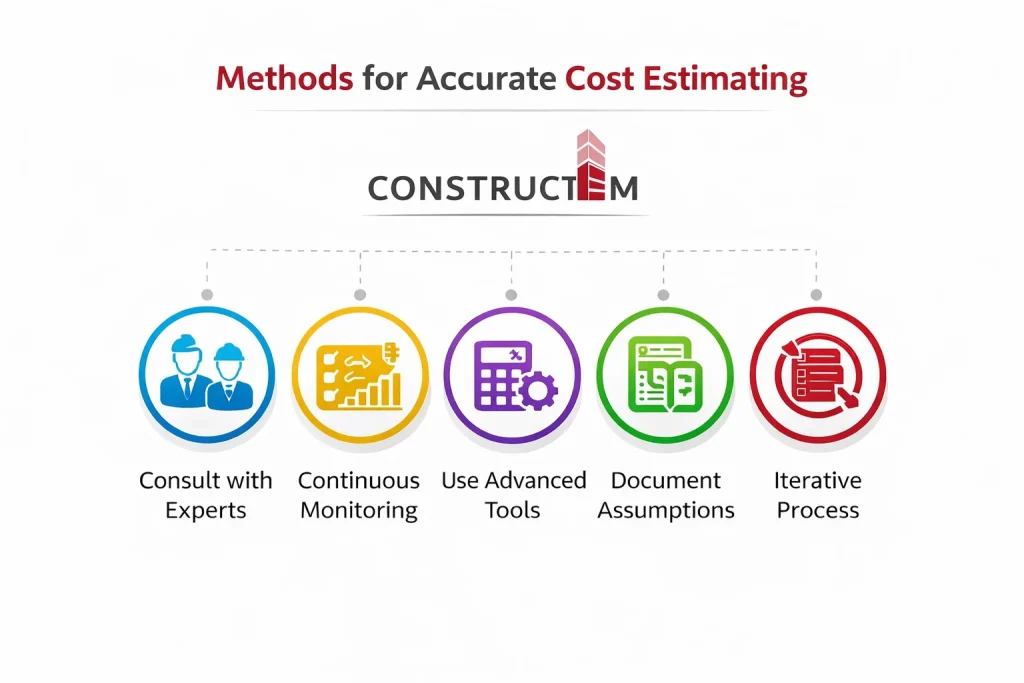
Methods for Accurate Cost Estimating
Producing accurate cost estimates requires more than following guidelines.
Best practices include:
- Consult with Experts: Work with professionals and subject matter experts to gain insight into specific project components.
- Continuous Monitoring: Track differences between projected and actual costs and update estimates as the project evolves.
- Use Advanced Tools: Tools like Plan swift and Bluebeam improve accuracy, automate calculations, and allow scenario analysis.
- Document Assumptions: Record all estimation assumptions to build trust between clients and estimators.
- Iterative Process: Understand that estimates evolve. Revise them as more information becomes available during planning and execution.
How to Calculate a Cost Estimate
Our construction cost estimate is calculated by combining all direct and indirect expenses along with contingency allowances to account for risk and uncertainty.
Basic Formula:
Total Cost = Direct Costs + Indirect Costs + Contingency
The following items, among others, are used to compute an accurate cost estimate:
Material costs: Cost of concrete, steel, finishes, fixtures and other building materials based on quantity take-offs and current market pricing.
Labor Costs: Skilled and unskilled wages, benefits, overtime and productivity rates.
Equipment Costs: Costs associated with the rental, operation, maintenance, fuel and transport of equipment and tools.
Costs for subcontractors: the electrical, plumbing, HVAC, and finishing trades.
Indirect Cost (Overhead): Site supervision, project management, insurance, permits, inspections, and office overhead.
Mobilization and Demobilization: Costs associated with establishment and dismantlement of site facilities, equipment, interim services.
Contingency Allowance: An amount expressed as a percentage to cover: unexpected conditions, change in design, and project risk.
Escalation: Cash flow adjustments, for inflation or future price increase, in projects of long duration.
Profit margin: An adequate margin is added for the contractors to safe keep for the project.
Cost estimating firms in Canada develop practical approaches that conform with each of these factors. This granular level of granularity is effective in reducing the financial risk, enhancing transparency, and facilitating greater cost control during the construction lifecycle.
Conclusion
Constructem’s cost estimating service in Canada is calculations at its extreme, end with expertise and attention to detail, and estimation is both a science and an art. Reliable cost estimates are essential for project management, financial planning and strategic decision making. Adhering to established industry standards as well as fundamental best practices allows clients to confidently deliver projects, stay on budget, and expect predictable results following delivery.
FAQs
What are cost estimating services?
Cost estimate services provide calculations of anticipated costs for labor, materials, equipment, overhead, permits and contingencies for construction estimation services or engineering projects. They assist contractors and clients to prepare for work, budgets, and financial risks.
What are the 4 types of cost estimates?
- Preliminary/Rough Estimate: Early stage, ±30–50% accuracy.
- Conceptual Estimate: Based on sketches or similar projects, ±15–30% accuracy.
- Detailed Estimate: Uses full plans and specifications, ±5–15% accuracy.
- Bid Estimate: For competitive bidding with detailed costs.
What are the different methods of estimation?
- Analogous: Based on past projects
- Parametric: Using unit rates
- Bottom-Up: Summing individual task costs
- Three-Point: Optimistic, pessimistic, and most likely costs
- Vendor Quotes: Using supplier or subcontractor quotes
How to calculate a cost estimate?
Total Cost = Direct Costs + Indirect Costs + Contingency add together materials, labor, equipment, overhead, and contingency to get the total project estimate.
