

Canada’s building sector is being transformed. Increasing material costs, more severe project schedules, a shortage of labor, and growing need to become more precise are forcing construction firms to reconsider traditional approaches to estimating. At the heart of this evolution is material takeoff services, an essential process that influences project budgets, timelines, and ultimate success.
Have you ever wondered why estimation companies place such strong emphasis on material takeoff services? Accurate material calculations are essential to a reliable construction estimate, and technology has revolutionized the way these takeoffs are done. With the help of our professional knowledge combined with innovative digital solutions, estimators today can provide results quicker, with greater accuracy, and at a lower cost than ever before. As Canada’s building industry grows increasingly sophisticated, technology is having a profound impact on what constitutes the takeoff of materials.
The Changing Landscape of the Canadian Construction Industry
Canada’s construction industry is facing a shifting landscape. Urbanization, population growth, infrastructure expansion, and sustainability goals are driving needs across residential, commercial, and industrial applications. But with material prices so volatile, and regulations so strict, controlling costs is proving harder than ever. you just can’t afford to have bad estimates on a construction project with the state of the economy these days knows that. Reliable material takeoff solutions are essential for builders, developers and project owners to reduce risk and wastage and help them stay competitive in bidding. A large contributor to meeting these demands, technology has enabled better efficiency, transparency, and accountability throughout the complete estimating process.
Why Material Takeoff Services Matter More Than Ever
Material takeoff services form the foundation of construction estimating. They consist of the takeoff of quantities of what a project needs in terms of materials as depicted by drawings and specifications. A mistake at this stage anywhere in the project can cause cost overruns, delays, or material shortages later on. In the Canadian market, where project budgets are often tight and compliance standards high, the question is How Canadian Construction Cost Estimators Manage Rising Cost even minor miscalculations can cause a great deal of trouble. Modern technology minimizes those risks by increasing accuracy of measurements and decreasing human error, and providing updates as the project evolves in real time.
Role of Artificial Intelligence in Material Takeoff
AI-based solutions process multiple sources of project data such as drawings, specifications, and past project records to determine material quantities with a high level of accuracy. AI-based programs can interpret multi-layered drawings far quicker and more reliably than traditional manual takeoffs. This reduces human error and time required to complete the estimating process,” he said. For high priority construction bids, AI definitely gives the edge in making turnaround time faster without losing quality. AI can also enhance decision making by comparing active project needs with historical data. This gives estimators greater confidence that they can spot cost trends, identify anomalies and refine bids.
AI Impacts on Construction Estimating
Speed and Efficiency
AI is significantly faster than manual takeoffs. Tasks that once took days can now be completed in hours, allowing estimators to meet tight deadlines and manage multiple projects simultaneously.
Accuracy and Cost Control
By automating measurements and material calculations, AI ensures that quantities are precise. This reduces over-ordering and under-ordering, helping contractors pay only for what is actually needed.
Predictive Analytics
AI-driven material takeoff services can forecast future costs based on historical data. These predictions account for material prices, labor rates, and project timelines, enabling estimators to prepare more accurate and risk-aware construction estimates.
Risk Mitigation Through Technology
Risk management is a major concern in Canadian construction projects. AI helps identify potential risks early in the estimating phase, such as material price fluctuations, supply chain delays, or weather-related disruptions.
By highlighting these risks in advance, contractors can include contingencies in their construction estimates. This proactive approach improves financial stability and reduces the likelihood of unexpected cost overruns during execution.
Automation in Material Takeoff Services
Automation is another game-changing benefit of modern technology. AI can handle repetitive and time-consuming tasks such as measuring quantities, identifying materials, and updating takeoff reports.
This allows estimators to focus on higher-value activities like strategic planning, value engineering, and bid analysis. Automation not only improves productivity but also ensures consistency across projects, which is critical for large-scale or multi-phase developments.
Integration with BIM and Digital Workflows
BIM and Digital Workflow Integration Building Information Modeling (BIM) is an additional technology that is influencing the material takeoff services in the near future. BIM models contain a wealth of information, enabling estimators to takeoff quantities from 3D models instead of 2D drawings.
With the addition of AI, cloud platforms and now BIM, a seamless estimating workflow is taking shape. Design changes are instantly updated in the quantity takeoffs and construction estimates, reducing rework and promoting collaboration among teams.
Benefits of Technology-Driven Material Takeoff Services
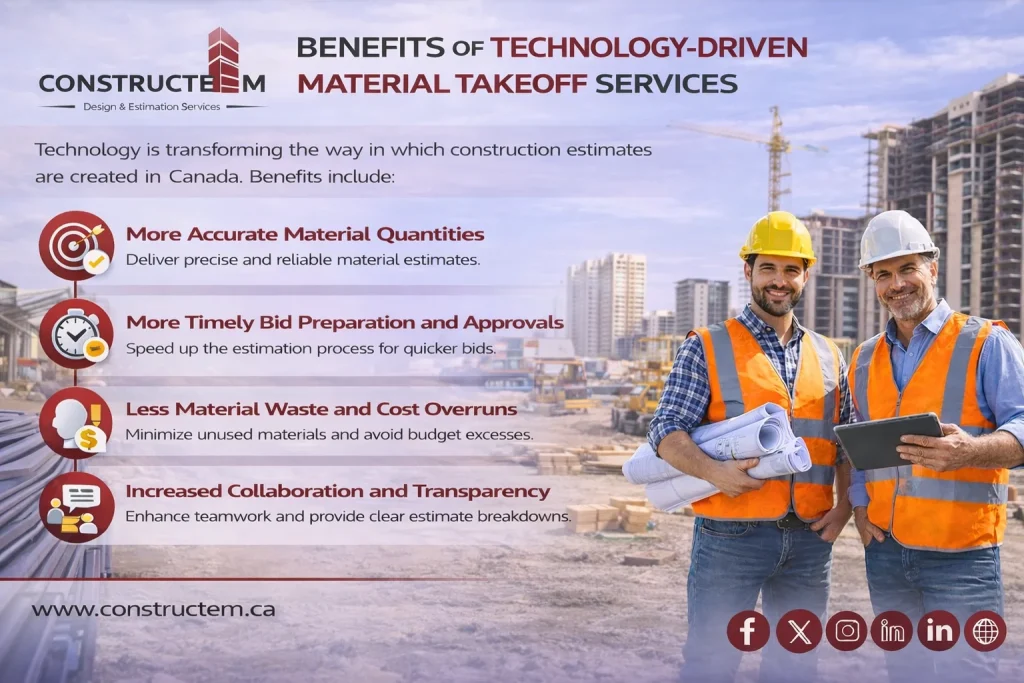
Technology is transforming the way in which construction estimates are created in Canada. Benefits include:
- More accurate material quantities
- More timely bid preparation and approvals
- Less material waste and cost overruns
- Increased collaboration and transparency
Better risk management and forecasting And these benefits help the construction firm remain competitive and provide projects on schedule and within budget.
The Future of Material Takeoff in Canadian Construction
With evolving technology, material takeoff services will be increasingly data-driven and automated. AI, cloud platforms, BIM and predictive analytics will converge to produce more intelligent, faster and more dependable construction estimates.
Conclusion
Technology is shaping the future of material takeoff in Canadian construction. Artificial Intelligence, cloud-based applications, automation and building information modeling (BIM) are reshaping the process of producing material takeoff services and construction estimates. Bringing these innovations to bear, professionals are empowered to increase accuracy, mitigate risk and afford their clients with open and reliable cost estimates at Constructem Canada.
With the direction of the industry moving forward, it will be necessary that the company keep pace with technology to remain competitive and project success. Technology-based material takeoff service are not the future, but the now serving as the standard for accurate and reliable construction estimates in Canada.
FAQS
What is material and quantity take off?
Material and quantity takeoff is the process of identifying and measuring all materials required for a construction project from drawings and specifications. It forms the foundation of accurate construction estimates, budgeting, and procurement.
What is the difference between material take off and quantity take off?
Material takeoff focuses on listing and specifying materials such as concrete, steel, lumber, and finishes. Quantity takeoff focuses on measuring exact quantities, such as lengths, areas, volumes, or counts needed for the project. Together, they ensure accurate construction estimates and cost control.
What is the difference between material take off and BOM?
A material takeoff is created during the planning and estimating stage and is used to calculate project costs and bids. A Bill of Materials (BOM) is typically used during procurement and manufacturing, listing exact items to be purchased, often with part numbers and suppliers.
